
How Long Does a Concrete Foundation Last on Houston Clay Soil?
Expansive clay is what defines Houston construction. Here is how foundations are specced to survive it.
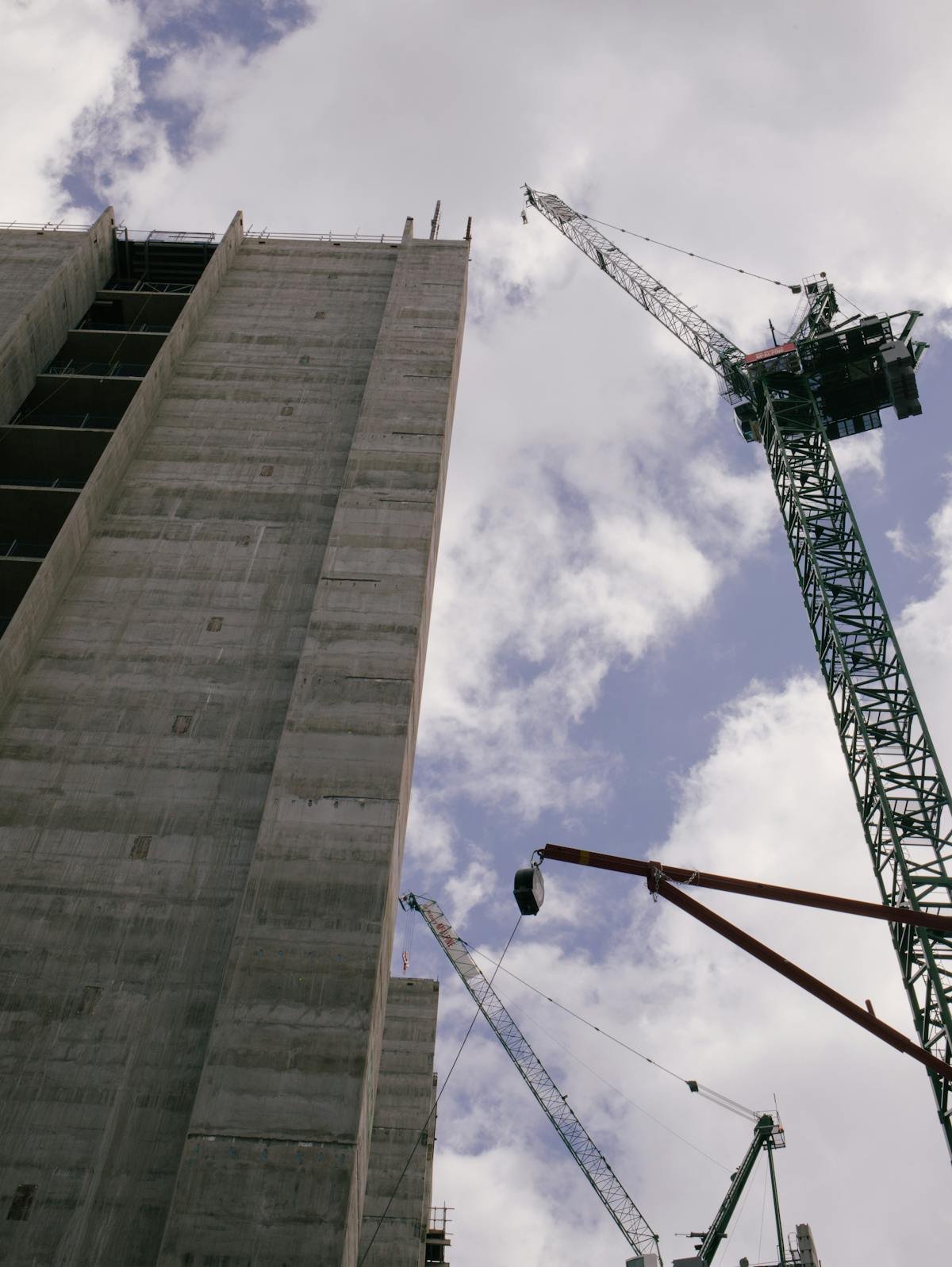
Concrete foundations in Houston do not fail because concrete is weak. They fail because the ground underneath them is alive.
Quick answer
A properly designed and installed concrete foundation slab in Houston should last 50 to 80 years. Houston's expansive clay soil (often called Beaumont clay or, locally, Houston gumbo) swells when wet and shrinks when dry, creating cyclical movement that destroys foundations not built to accommodate it. The fix is engineering: deeper base preparation, heavier reinforcement, and proper moisture management.
What expansive clay actually does
Houston sits on a thick layer of marine clay deposited millions of years ago when the Gulf of Mexico extended further inland. The clay particles are flat plates that attract water molecules between them like a stack of sponges. When the soil takes on water (spring rains, summer thunderstorms, irrigation), the plates push apart and the soil swells — sometimes lifting structures by inches. When the soil dries out (late summer drought, tree roots pulling moisture), the plates collapse and the ground sinks.
A foundation slab sitting directly on this clay experiences this movement as differential pressure under different parts of the slab simultaneously. The slab cracks, separates from connecting structures, tilts, or settles unevenly. None of this is the concrete's fault — it is the soil moving while the slab tries to stay put.
The three layers under every Houston foundation
A foundation slab properly built for Houston clay has three distinct components below the concrete:
1. Subgrade preparation
Before any material is placed, the native clay is graded and proof-rolled. Proof-rolling means driving a loaded vehicle over the soil to identify soft or unstable areas that will continue to settle after construction. Soft spots are excavated and either replaced with engineered fill or stabilized chemically (lime treatment).
On most residential additions and ADUs, proof-rolling is informal — we observe the surface and probe with a rod. For permitted projects over 500 sq ft, a geotechnical engineer may specify a more rigorous procedure.
2. Base course (select fill)
Over the prepared subgrade we place 4 to 6 inches of compacted crushed limestone (often called "select fill" or "Type B" depending on the supplier). This layer spreads the slab's load over a larger soil area and provides a stable, drained working platform.
The base is compacted in lifts (2-3 inch layers each compacted separately) to maximum density. A 6-inch base placed in a single lift and barely walked on is functionally a 2-inch base — uncompacted base is one of the most common failure modes we see.
3. Vapor barrier
For habitable structures (anything with a finished interior floor), a 10-mil polyethylene vapor barrier sits directly under the concrete to prevent ground moisture from migrating up into the building. The barrier is lapped at seams, taped, and turned up at edges where the slab meets the perimeter.
Vapor barriers are not required by code for some unconditioned structures (open-air carports, some detached garages) but we install them as standard on anything that might later be enclosed.
Reinforcement: rebar grid vs. post-tension
Rebar grid
The standard residential reinforcement for Houston additions, ADUs, garage slabs, and most foundation work is a rebar grid: #4 rebar (1/2 inch diameter) at 12 to 18 inch centers in both directions, tied at intersections, supported on rebar chairs at mid-slab depth. The grid handles the tensile forces created when the soil moves underneath.
Rebar grids are reliable, repairable in the field if conditions are discovered to require adjustments, and standard practice across the Houston market.
Post-tension
Post-tension foundations use steel cables (typically 1/2 inch high-strength strand) running in plastic sheaths inside the slab. After the concrete cures partially, the cables are tensioned with hydraulic jacks and anchored at the slab edges. The tensioned cables put the slab into compression, which resists cracking under load.
Post-tension is common in new Houston home construction because it allows thinner slabs on engineered fill. For residential additions tied to existing foundations, post-tension introduces compatibility issues that usually argue for rebar grid instead.
Slab edge thickening
The perimeter of a habitable structure's slab is typically thickened to a "turned-down beam" — the slab edge extends 8 to 12 inches deeper than the slab body, like an inverted L. The edge beam bears the load of the exterior walls and provides resistance against the soil pushing inward.
Engineer-specified edge beams may be much larger than this standard, especially for sites with poor soil or significant load (heavy masonry walls, multi-story additions). Always follow the engineer's spec on permitted projects.
Curing in Houston heat
Concrete strength is a chemical reaction (hydration) that requires water and time. In Houston summers, ambient temperatures over 95°F evaporate water from the slab surface faster than the chemistry can use it, causing premature curing of the top and weaker, dustier surfaces.
The two ways we manage this:
- Schedule pours in the early morning (5-9am) so the bulk of the cure happens before ambient temperatures peak.
- Wet cure the slab for the first 7 days — covered with plastic or wet burlap, or sprayed multiple times daily, keeping the surface continuously moist.
For premium projects we use evaporation retarders sprayed on the surface immediately after finishing to slow water loss while the slab finishes setting.
How long until usable
| Stage | Time from pour | What is possible |
|---|---|---|
| Initial set | 2-4 hours | Surface no longer dents under thumb |
| Walk-on | 3-5 days | Foot traffic with care |
| Frame above | 5-7 days | Wood framing can start |
| 70% strength | 7 days | Light loads |
| Full design strength | 28 days | Vehicle weight, masonry above |
Permits and engineers
Foundation work inside the City of Houston requires a building permit when the project is part of a new structure, an addition over 500 sq ft, or a structural alteration. Small detached structures (storage sheds under specific size limits, certain open-air carports) may be exempt.
For permitted projects, the city typically requires a Texas-licensed structural engineer's sealed drawing of the foundation. We coordinate with engineers we work with regularly. Engineer fees are itemized in your written estimate.
Bottom line
The lifespan of a Houston foundation is determined more by base preparation and engineering than by anything that happens in the concrete itself. Investing in proper proof-rolling, a deep compacted base, correct reinforcement, and proper cure routine is what separates a 60-year foundation from a 12-year repair job.
Have a project in mind?
Free written estimate within 24 hours of the site visit. No deposit.
Get a free quote